10 Best Boiler Pumps for Global Buyers in 2026

Boiler pumps are small components with a large influence on heating reliability, operating cost, and carbon performance. The International Energy Agency reports that buildings consume about 30% of global final energy and produce roughly 26% of energy-related emissions. Heating remains a major part of that demand, especially in colder commercial and industrial facilities. Efficient circulation is therefore not a minor engineering detail.

This guide, “10 Best Boiler Pumps for Global Buyers in 2026,” evaluates pumps through practical purchasing criteria. These include flow rate, head pressure, motor efficiency, temperature tolerance, control compatibility, maintenance access, and verified service support. The U.S. Department of Energy identifies pumping systems as significant electricity users in many industrial facilities. Its guidance also stresses correct sizing and variable-speed control. Oversizing can create noise, wasted power, and unstable balancing. Undersizing may leave distant radiators cold.

International buyers must also consider regional standards. EN 12828 supports safe design for water-based heating systems, while ASHRAE guidance helps assess commercial HVAC performance. Product claims should be checked against test methods, certifications, warranty terms, and real installation records. A glossy efficiency label is not enough. Field conditions are messier.

No ranking is universal. A compact wet-rotor pump may suit a hotel retrofit, while a heavy-duty inline model may better serve a factory. Voltage, water quality, glycol concentration, pipe layout, and local technical support can change the result. The following selection is useful, but not perfect. Buyers should verify every specification against their own system before placing an order.

10 Best Boiler Pumps for Global Buyers in 2026

What Boiler Pumps Do and Why They Matter in Modern Heating Systems

Boiler pumps move heated water from the boiler to radiators, coils, or underfloor circuits. They maintain flow, transfer heat, and protect equipment from uneven temperatures. A correctly selected pump also reduces noise, vibration, and unnecessary electricity use.

The International Energy Agency reports that buildings consume about 30% of global final energy and produce roughly 26% of energy-related emissions. Efficient circulation therefore matters beyond the plant room. Variable-speed pumps adjust output as thermostatic valves close or heating demand changes. The U.S. Department of Energy notes that variable-speed operation can significantly reduce pump energy consumption, especially in systems with changing loads. Small controls can create measurable savings.

However, efficiency labels can mislead. A pump with excellent laboratory performance may perform poorly after incorrect sizing. Field commissioning often finds excessive flow, unbalanced circuits, or air trapped near the impeller. These faults increase wear and operating costs. The Hydraulic Institute emphasizes matching pump duty to actual system flow and head, not maximum advertised capacity. Check valve position, water quality, glycol concentration, and minimum flow requirements. Cavitation sounds like gravel inside the casing. It is not harmless. Selection should also consider voltage, ambient temperature, control compatibility, service access, and local safety rules. Real systems are imperfect. Designers should leave room for measured adjustment, not guesswork.

10 Best Boiler Pumps for Global Buyers in 2026 - What Boiler Pumps Do and Why They Matter in Modern Heating Systems

Boiler pumps move water, feedwater, or returned condensate through heating and steam systems. The options below are pump configurations matched to common applications—not a universal product ranking. The best choice depends on the system duty and site conditions.

Boiler Pump Types and Application Guide for Global Buyers
No. Pump Type or Configuration Best-Fit Application Indicative Flow Range Indicative Head Range Why It Matters Key Buyer Checks
1 Wet-rotor circulator Small and medium closed-loop hot-water heating systems About 0.1–20 m³/h About 2–15 m Compact design; the pumped fluid lubricates and cools the rotor in suitable systems. Check water quality, temperature limits, system pressure, connection size, and whether the pump is suitable for the circuit fluid.
2 ECM variable-speed circulator Hydronic systems with changing heating demand or zone-valve operation About 0.1–20 m³/h About 2–15 m Electronic speed control can adjust pump output to system demand and may reduce pumping energy compared with constant-speed operation. Confirm control mode, electrical supply, sensor or communication requirements, and compatibility with the system hydraulics.
3 In-line centrifugal pump Commercial heating distribution and larger boiler-room circuits About 1–200 m³/h About 5–30 m Its in-line connections can simplify installation in a straight pipe run and support higher flows than many small circulators. Review the pump curve, pipe alignment, motor access, allowable fluid temperature, and maintenance clearances.
4 End-suction centrifugal pump Large heating-water circulation, transfer, and general boiler-room duties About 5–500 m³/h About 5–100 m A widely used configuration with a broad range of capacities and service options. Check foundation and alignment needs, suction conditions, seal materials, motor arrangement, and the operating point on the pump curve.
5 Vertical multistage centrifugal pump Boiler feed, pressurization, and make-up-water duties where higher head is required About 0.5–100 m³/h About 20–300 m Multiple impeller stages can provide higher discharge pressure within a relatively compact footprint. Verify feedwater temperature, suction pressure, NPSH conditions, materials, pressure rating, and motor suitability.
6 Horizontal multistage centrifugal pump Boiler feed and high-pressure water transfer in industrial installations About 0.5–100 m³/h About 20–300 m Staged impellers are suited to duties requiring more head than a typical single-stage pump can provide. Check the required feed pressure, temperature, NPSH available, seal and bearing arrangement, and service access.
7 Close-coupled centrifugal pump Compact boiler packages and smaller transfer or circulation duties About 1–100 m³/h About 5–80 m The pump and motor share a compact assembly, which can reduce footprint and simplify installation. Confirm duty point, motor protection, temperature rating, vibration limits, and whether the unit can be serviced without major pipework removal.
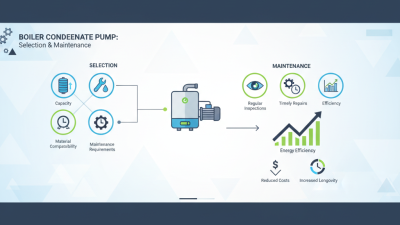
8 Condensate return pump Moving collected condensate from a receiver to a boiler feed tank or return line About 0.1–50 m³/h About 5–50 m Recovering condensate can return usable heat and treated water to the steam system. Account for condensate temperature, receiver arrangement, air handling, suction conditions, corrosion risk, and required discharge pressure.
9 Duplex boiler-feed pump set Boiler installations requiring alternating or standby feed pumps About 0.5–100 m³/h per pump About 20–300 m per pump Two pumps can provide duty/standby or alternating operation, helping maintain feedwater availability when one pump is unavailable. Specify the control panel, changeover logic, alarms, check valves, receiver or tank arrangement, and applicable local boiler requirements.
10 Regenerative turbine pump Low-flow, relatively high-head duties, including some small boiler-feed applications About 0.05–5 m³/h About 20–200 m Can provide comparatively high head at lower flow than many general-purpose centrifugal pumps. Confirm fluid temperature and vapor pressure, minimum flow requirements, suction conditions, and the manufacturer’s operating limits.

Selection note: Flow and head figures are broad indicative screening ranges, not guaranteed ratings or a substitute for a manufacturer’s pump curve. Final selection should use the required duty point and account for fluid temperature, pressure, viscosity, water quality, NPSH, materials, electrical supply, local codes, and the boiler system’s operating requirements.

Key Criteria for Comparing Boiler Pumps for Global Applications

When comparing boiler pumps for global applications, buyers should start with duty conditions, not catalog size. Required flow, total head, fluid temperature, pressure, and water chemistry determine whether a pump will operate safely. The IEA’s Energy Efficiency 2023 report notes that buildings consume about 30% of global final energy. Efficient circulation therefore affects both operating cost and emissions. Yet efficiency claims can mislead when tested under different conditions.

Check the pump curve at the real duty point. A pump running far from its best efficiency point may create noise, vibration, and premature seal wear. Motor voltage, frequency, enclosure rating, and control compatibility also matter across markets.

The European Commission’s circulator rules use an Energy Efficiency Index threshold of 0.23 for covered products. That benchmark helps, but it does not replace a full lifecycle review.

The U.S. Department of Energy also identifies pumping systems as a major industrial electricity load, often around 25%. Boiler applications vary, so this figure should not be treated as a universal result.

Tips: Request certified test data, not only marketing percentages. Confirm materials against oxygen levels, glycol concentration, and local water treatment. Review spare-part access and service skills before purchase. A lower purchase price may become expensive after two heating seasons. Perfect comparisons are rare. Leave room for site measurements, because drawings are sometimes outdated. Experienced technicians should verify NPSH, minimum flow, and pressure limits before commissioning.

The 10 Best Boiler Pumps for Different Heating System Needs

A useful list of the 10 best boiler pumps should match real heating needs, not just compare flow rates. For compact homes, a variable-speed circulator can adjust output as zone valves open and close. A fixed-speed circulator may suit a simple, steady circuit. Multi-zone systems often benefit from individual zone circulators or a properly sized central pump. Noise matters.

For long pipe runs or tall buildings, a high-head pump may overcome greater resistance, but oversizing can waste energy and create flow noise. Low-temperature systems, such as underfloor heating, usually need careful flow control and may require a mixing arrangement. Older radiators can call for a pump suited to higher operating temperatures. In systems with separate boiler and heating circuits, a primary-loop pump can help maintain dependable circulation.

Other useful choices include a compact pump for tight plant rooms, a corrosion-resistant model for compatible system fluids, a twin-head pump where continued circulation is important, and a smart circulator with pressure control. Check the system’s required flow, total head, temperature range, connection size, and electrical supply before buying. A specification sheet rarely tells the whole story; air in the pipes, dirty strainers, or incorrect balancing can undermine even a well-matched pump. Have the final duty point verified against the boiler and system design.

10 Best Boiler Pumps for Global Buyers in 2026

The 10 Best Boiler Pumps for Different Heating System Needs

This comparison uses representative design requirements for hydronic heating systems. Flow rates are shown in litres per minute, while pump head indicates the pressure required to overcome system resistance. Actual selection should be verified against pipe length, valve resistance, heat output, fluid temperature, and local electrical standards.

How to read the chart: Higher flow capacity is generally required for larger heating zones, commercial fan-coil systems, and high-rise applications. Higher pump head is important where pipe runs, valves, heat exchangers, or elevation create greater resistance.

Installation, Sizing, and Compatibility Factors to Check

Choosing among the 10 best boiler pumps for global buyers in 2026 requires more than comparing flow rates. Installation conditions often determine long-term performance. Measure the pipe diameter, connection type, available space, and service clearance before ordering. A pump that fits the catalog may not fit the plant room.

Sizing should match both flow and head requirements. Calculate the system resistance, including valves, bends, heat exchangers, and elevation changes. Do not select a larger pump “for safety.” Oversizing can create noise, high energy use, and unstable temperature control. Check the manufacturer’s performance curve at the actual operating point. Record water temperature, pressure, and fluid composition during commissioning. Small details matter.

Compatibility also deserves careful inspection. Confirm the voltage, frequency, motor protection, control signal, and maximum operating temperature. Global installations may use different electrical standards, even within one region. Check whether seals, impellers, and housing materials suit treated water or glycol mixtures. Install isolation valves and a strainer where required, then flush the pipework before startup. Keep the shaft correctly aligned. It is easy to overlook this. In practice, installation drawings can be incomplete, and field conditions may differ from the original survey. Recheck measurements on site. A short trial run, followed by vibration and temperature checks, can reveal problems before they become expensive failures.

Maintenance, Energy Efficiency, and Long-Term Operating Costs

10 Best Boiler Pumps for Global Buyers in 2026

Maintenance, Energy Efficiency, and Long-Term Operating Costs

Selecting among the 10 best boiler pumps in 2026 requires more than comparing purchase prices. Maintenance access, hydraulic fit, and measured energy use shape the real cost. Energy quietly compounds. The International Energy Agency estimates that electric motor systems consume roughly half of global electricity. Pumps represent an important share of that demand.

The International Energy Agency estimates that electric motor systems consume roughly half of global electricity.

The U.S. Department of Energy reports that pumping systems can consume 25–50% of an industrial facility’s electricity. This wide range exposes the risk of oversized motors and constant throttling. An efficient boiler pump should match design flow and head, not maximum advertised capacity. Variable-speed control may reduce partial-load waste, but savings depend on controls, resistance, and commissioning. Testing matters.

Testing matters.

During site reviews, technicians should inspect seals, bearings, strainers, vibration, and differential pressure. A blocked strainer can quietly increase head loss. A worn seal can turn a minor fault into downtime. DOE lifecycle guidance treats energy, maintenance, and replacement costs as part of total ownership. Hydraulic Institute guidance also emphasizes operation near the best efficiency point, supporting reliability and lower consumption. Perfect conditions are rare. Schedules slip. Water quality, corrosion, and seasonal loads change assumptions. Buyers should request factory test data, service intervals, spare-part availability, and a realistic five-year energy estimate. These documents often reveal whether projected savings can survive actual boiler-room conditions.